
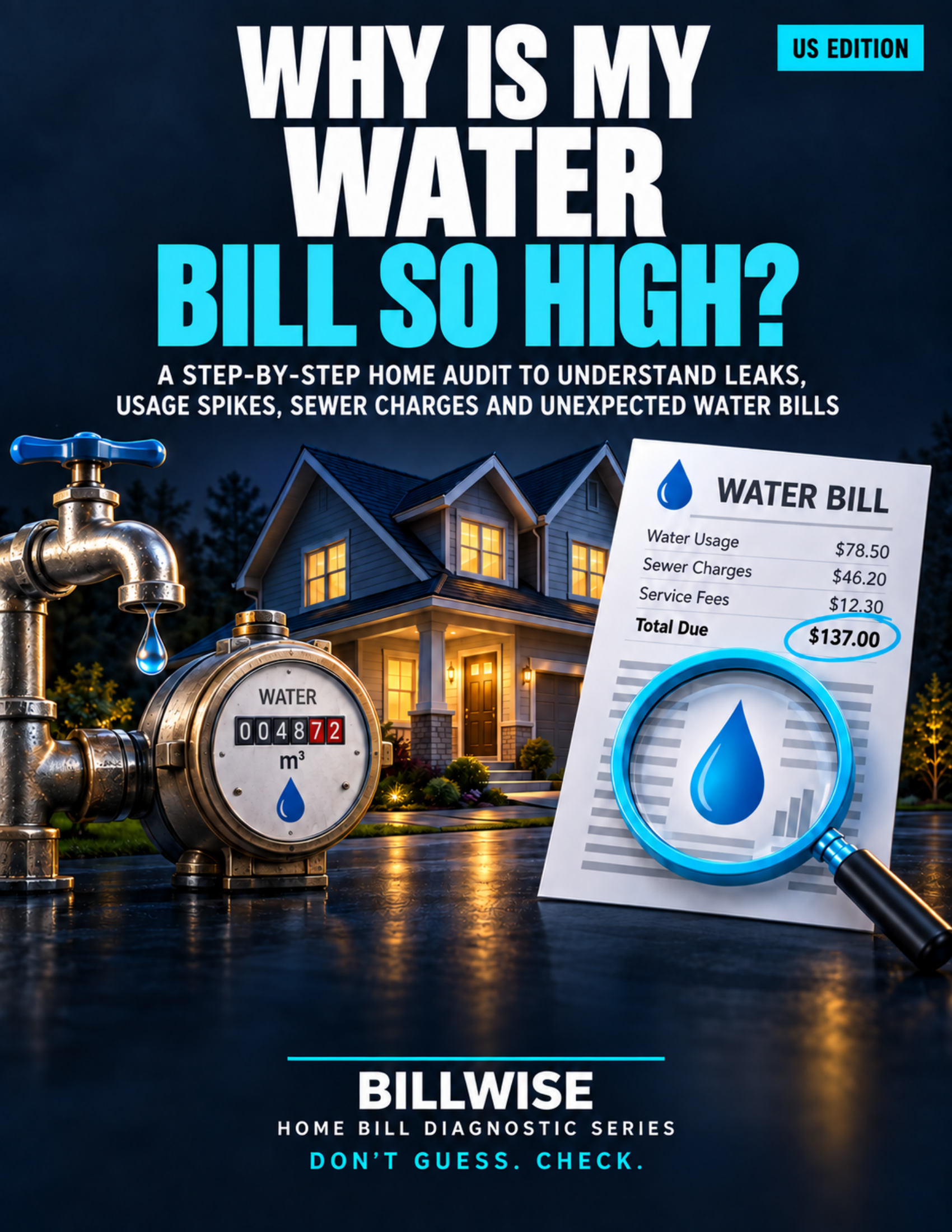
Cover · Diagnostic Guide
Unexpected water bill? Find out what changed.
Compare usage, billing days, rates and fees, sewer charges, meter readings and possible leaks — with a step-by-step guide to help you identify what changed and what to ask next.
Launch price
Preview the guide
Preview real pages from the guide. Select any interior page to inspect it at a larger size.
Cover · Diagnostic Guide
Start Here · Page 2
B.I.L.L. Method · Page 4
Bill Snapshot · Page 5
Included in your $12.99 guide
Use worksheets, checks and decision paths to compare your bill, isolate what changed and know what to do next — without piecing together answers from dozens of searches.
Compare your current bill, previous bill and the same season last year.
Separate changes in usage, billing days and daily cost before you assume what went wrong.
Run a no-water meter test, silent toilet test and visible-fixture checklist.
Follow the evidence toward the right path: usage, billing, leaks, meter/read issues or shared billing.
Bring the right numbers and use specific questions when you contact your utility or billing provider.
Finish with three priority actions based on the evidence you found.
Not just 33 pages to read — a guided investigation you can actually work through.
Problem awareness
Several factors can move at the same time. Checking them in a fixed order is what turns a confusing total into a specific answer.
More people, more laundry, more irrigation. Real usage changes are the most common single factor.
A running toilet or an underground line can move a large volume without any visible sign.
The price per unit can change, or a tiered rate can push part of your usage into a higher band.
Fixed service charges apply regardless of usage and can be adjusted separately from rates.
Many utilities calculate sewer volume from metered water, so one change can raise two lines.
A misread digit or a reversed reading can produce a total that does not match reality.
A 36-day period is not comparable to a 28-day period, even at identical daily usage.
An estimate followed by an actual reading can arrive as one unusually large catch-up bill.
Outcomes
Inside the guide
Each part of the guide walks through one area in a clear order, from the first check to a practical next step.
Line up two statements and read the same fields.
Separate a real usage change from a billing change.
Check whether the price per unit moved.
Identify service charges that apply regardless of usage.
Understand how sewer lines can follow water volume.
Spot estimated reads and catch-up adjustments.
Run simple indoor and outdoor leak indicator checks.
Map the fixtures and habits behind the numbers.
Prepare the questions worth asking, in order.
Close with your three most important next steps.
The B.I.L.L. Method
This guide concentrates on understanding the numbers and identifying what changed.
Gallons per day, cost per day and billing days.
Usage, leaks, sewer charges, rates and meter timing.
Practical household water routines over 30 days.
Tracking pages and a monthly review habit.
Compare
Understand the problem
Investigate the bill, usage, rates and meter timing in a clear order.
Follow a 30-day plan
Turn what you learn into focused daily checks and repeatable routines.
Get both
Use the diagnostic first, then work through the matching 30-day plan.
Independent editorial work
Water bills vary by household, utility, location, billing period, rates and usage. BillWise guides provide education, organization and practical next steps. They do not guarantee a lower bill.
Utilities, public agencies and consumer organizations provide useful free information about utility usage and billing. BillWise does not claim ownership over that information.
The value of the guide comes from organizing the investigation into a practical step-by-step workflow so readers do not need to search across many disconnected sources to understand what to check next.
Read our editorial standardQuestions
$12.99 • one-time payment
A practical step-by-step guide for investigating unexpectedly high water bills.
Secure checkout • PDF delivered by email after purchase
Why Is My Water Bill So High?
$12.99